Mold Design
We Structure the Process Correctly from the Start
What Is Mold Design?
Mold design is the process of creating the technical and engineering foundation for the mold to be used in plastic injection production.
This stage is not merely about preparing technical drawings; it is a critical engineering phase where production scenario, risk analysis and long-term performance planning are carried out.
At Senkron Group Plastik, mold design is planned with manufacturing and production reality in mind.
Request Technical Quote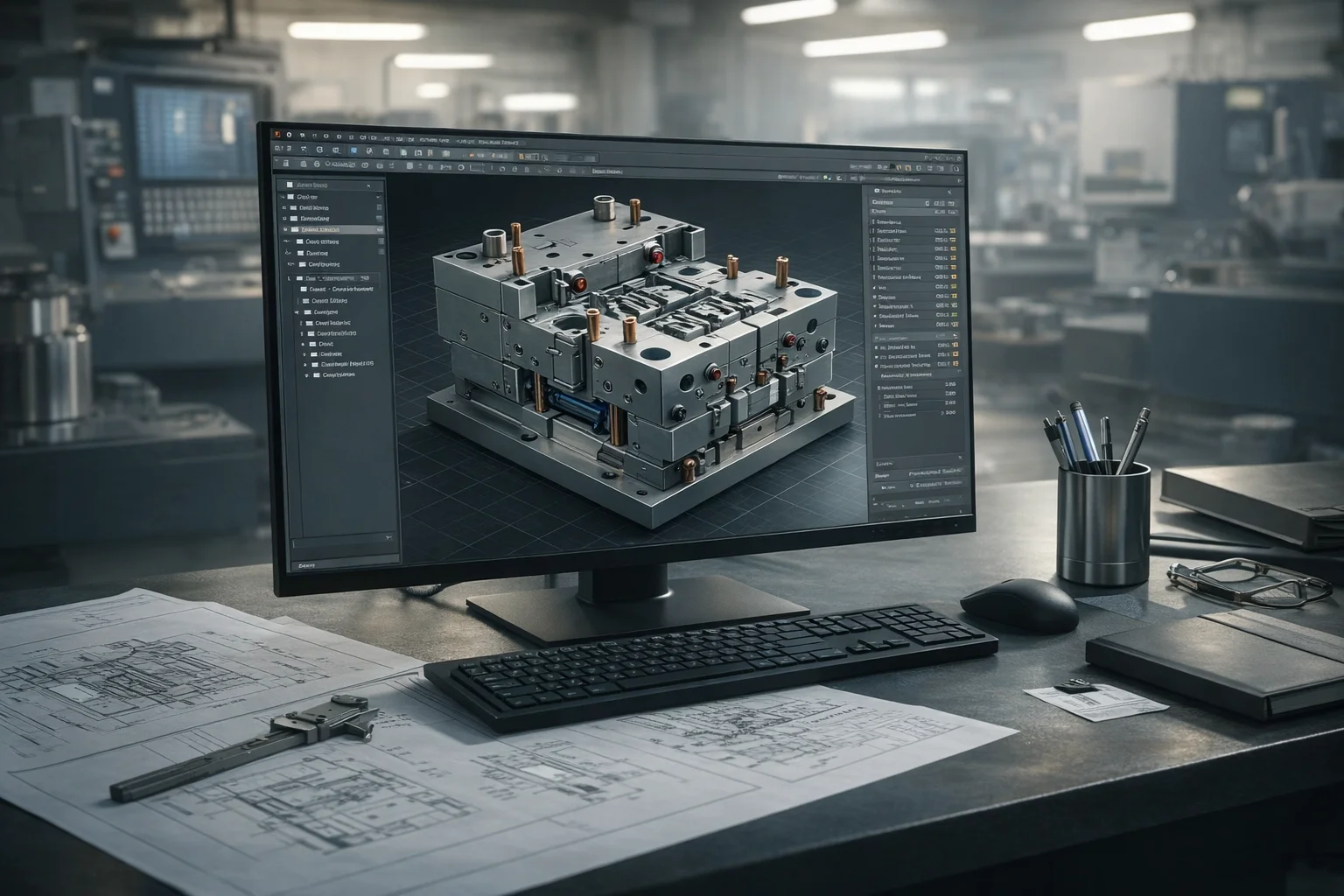
How Does the Process Work?
1Technical Data Review
The project starts with technical data analysis.
- STEP, IGES and similar 3D files are reviewed
- Dimensional and geometry analysis can be performed from sample
- Wall thicknesses and transition zones are checked
- Tolerance expectations are evaluated
Manufacturability analysis is carried out at this stage and design improvement suggestions are offered when needed. The aim is to identify potential risks before manufacturing.
2Production Scenario Planning
Mold design is shaped by the production scenario.
The following are determined at this stage:
- Plastic raw material to be used
- Production volume
- Number of cavities
- Gate and shut-off strategy
- Cooling concept
- Ejector and mechanical system layout
The goal is not only to design a working mold but to create a sustainable structure in terms of cycle time, part quality and mold life.
3Prototype & Pre-Validation (When Required)
Pre-validation work may be carried out for critical geometries or projects requiring high precision.
- 3D printer output
- Pre-sample production
- Dimensional check in critical areas
This step reduces the revision risk that may arise at the trial stage.
4Design Approval & Revision
The prepared mold design is submitted for customer approval.
At this stage:
- Technical details are clarified
- Revisions are applied
- Final design version is created
Mold manufacturing does not start until the design process is complete.
Why Do We Work This Way?
Many problems encountered in production stem from details overlooked at the design stage.
Therefore the following are especially evaluated in the design process:
- Possible deformation (warpage) risks
- Fill balance and flow analysis
- Flash formation potential
- Part ejection and ejector positioning difficulties
- Cooling imbalance
- Long-term mold wear points
The aim is to solve problems at the design stage, not during production.
Advantage of the Integrated Structure
When mold design, mold manufacturing and injection production are carried out within the same organization, design decisions are tested directly against production reality.
This structure:
- Reduces theoretical risks
- Lowers revision likelihood
- Shortens commissioning time
- Speeds up production handover
At Senkron Group Plastik, design is done to work on the shop floor—not only in the CAD environment.
Frequently Asked Questions
What is included in mold design scope?
Part analysis, gate and shut-off strategy, cooling concept, mechanical system layout, ejector system planning and manufacturability assessment are included. The aim is to ensure the mold runs smoothly in production.
How long does mold design take?
Duration depends on part complexity, number of cavities, mechanical system requirements and revision needs. Simple projects take less time; design time increases for multi-cavity or moving-mechanism molds.
Can design optimization reduce mold cost?
Yes. Design-for-manufacturing decisions reduce unnecessary mechanical complexity, lower revision risk, improve cycle time and reduce long-term maintenance costs, which positively affects total project cost.
- Reduces unnecessary mechanical complexity
- Lowers revision risk
- Improves cycle time
- Reduces long-term maintenance costs
How is deformation risk assessed in mold design?
Part geometry, wall thickness transitions, material selection and cooling balance are analyzed together. Where necessary, flow and fill simulations are used to identify warpage and shrinkage risks in advance.
Does manufacturing start without design approval?
No. Mold manufacturing does not start until the final design has passed customer approval. This approach aims to avoid costly revisions later.
Is prototype work required for every project?
No. However, pre-validation may be recommended for complex geometries, parts requiring tight tolerances or new product development projects. This step reduces risks before serial production.