Plastic Injection Manufacturing
Controlled Transition from Mold to Serial Production
What Is Plastic Injection?
Plastic injection is the process of melting thermoplastic material, injecting it into the mold under high pressure, and shaping it through controlled cooling.
This method provides dimensional repeatability, surface quality and high-volume production efficiency in serial production.
At Senkron Group Plastik, the injection process is not just part production; it is run with process control, quality tracking and a sustainable production approach.
Request Technical Quote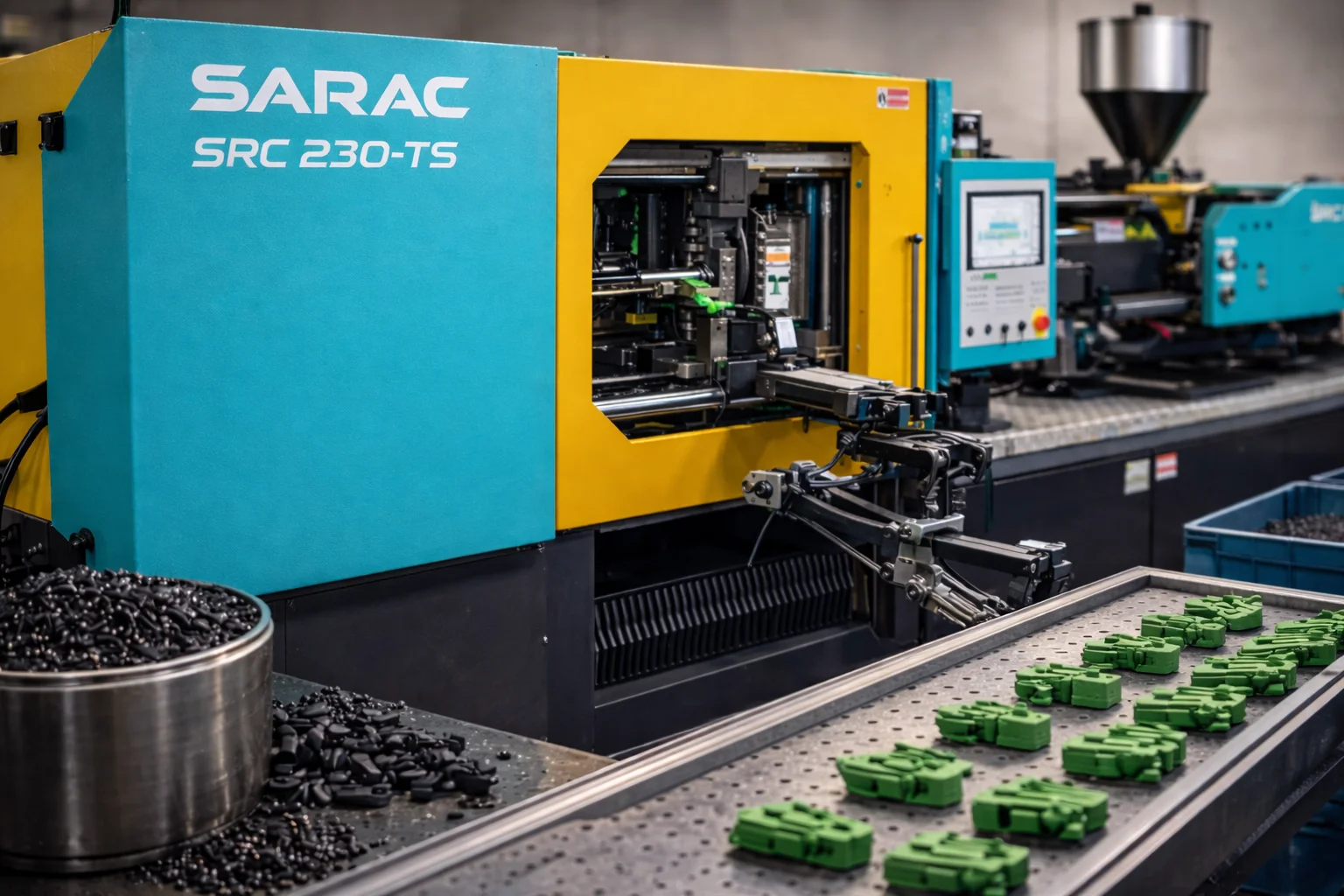
How Does the Process Work?
1Determining Material and Production Parameters
Before production, the plastic material to be used (e.g. PP, ABS, PA) is determined.
Evaluated at this stage:
- Flow properties
- Shrinkage rate
- Heat resistance
- Mechanical performance expectations
Machine parameters (injection pressure, temperature, holding pressure, cooling time) are set accordingly.
2Mold Mounting and Trial Settings
The mold is mounted on the injection machine and initial setting work is carried out.
- Injection speed
- Pressure balance
- Fill time
- Cooling time
are optimized. The aim is to achieve a part with balanced fill and dimensional stability.
3Serial Production
After parameters are validated, serial production starts.
During production the following are monitored:
- Part dimensions
- Surface quality
- Flash control
- Color stability
- Cycle time
Process parameters are recorded and production repeatability is ensured.
4Quality Control and Dispatch
After production, parts are checked against defined quality criteria.
When necessary:
- Dimensional check
- Function tests
- Visual quality inspection
Approved products are prepared for dispatch.
Why Do We Work This Way?
In plastic injection manufacturing, quality depends not only on the mold but on process control.
Therefore during production the following are continuously monitored:
- Parameter stability
- Cooling balance
- Pressure control
- Machine repeatability
The aim is not only to produce but to ensure the same quality in every cycle.
Advantage of the Integrated Structure
When mold design, mold manufacturing and injection production are carried out within the same structure:
- Mold-related issues are resolved quickly
- Parameter optimization is faster
- Revision time is shortened
- Production handover is more controlled
This integration reduces external dependency and ensures production continuity.
Frequently Asked Questions
What materials can be used for plastic injection?
Production can be carried out with many thermoplastic materials such as PP, ABS, PA, POM, PE and similar. Material selection is determined according to the intended use of the part.
Is there a minimum quantity in plastic injection production?
Minimum quantity depends on part structure, mold condition and production planning. As it is a serial production method, more efficient results are obtained at higher quantities.
How is quality ensured in injection production?
Machine parameters are kept under control, first-piece approval is carried out and dimensional and visual quality checks are performed throughout production. Process data is recorded to ensure repeatability.
What does cycle time depend on?
Part geometry, wall thickness, material used and cooling layout determine cycle time. An optimized mold and correct parameter settings shorten cycle time.
Is re-adjustment required after mold change?
Yes. Injection parameters are re-optimized for each mold. This is necessary for production stability.